
Running a Marion County Sex Offender Check
Two official paths serve a Marion County sex offender check. The Arkansas Sex Offender Notification System, managed by the Arkansas Crime Information Center, is the main statewide search. It accepts county, city, ZIP, address, place, and name criteria. The Marion County Sheriff's Office registry display adds a local list and a vital warning about its limits.
Start with the state portal when the aim is a broad Marion County map or name search. Read the sheriff's disclaimer before relying on a local entry. The sheriff says posted addresses may be wrong due to improper reporting or public-record errors, and the local website is not a complete list of all people required to register with the office. Neither the jail roster nor ARCH replaces the registry.
Marion County Registry Disclaimer
The sheriff's warning changes how a local result should be read. A blank local list does not establish that no registrant is present, and a displayed address should not be treated as verified forever. Registry information can shift quickly. If a Marion County address seems wrong, send the concern to the Sheriff's Office rather than confronting anyone listed.
The official disclaimer is visible in the Marion County registry source shown below.
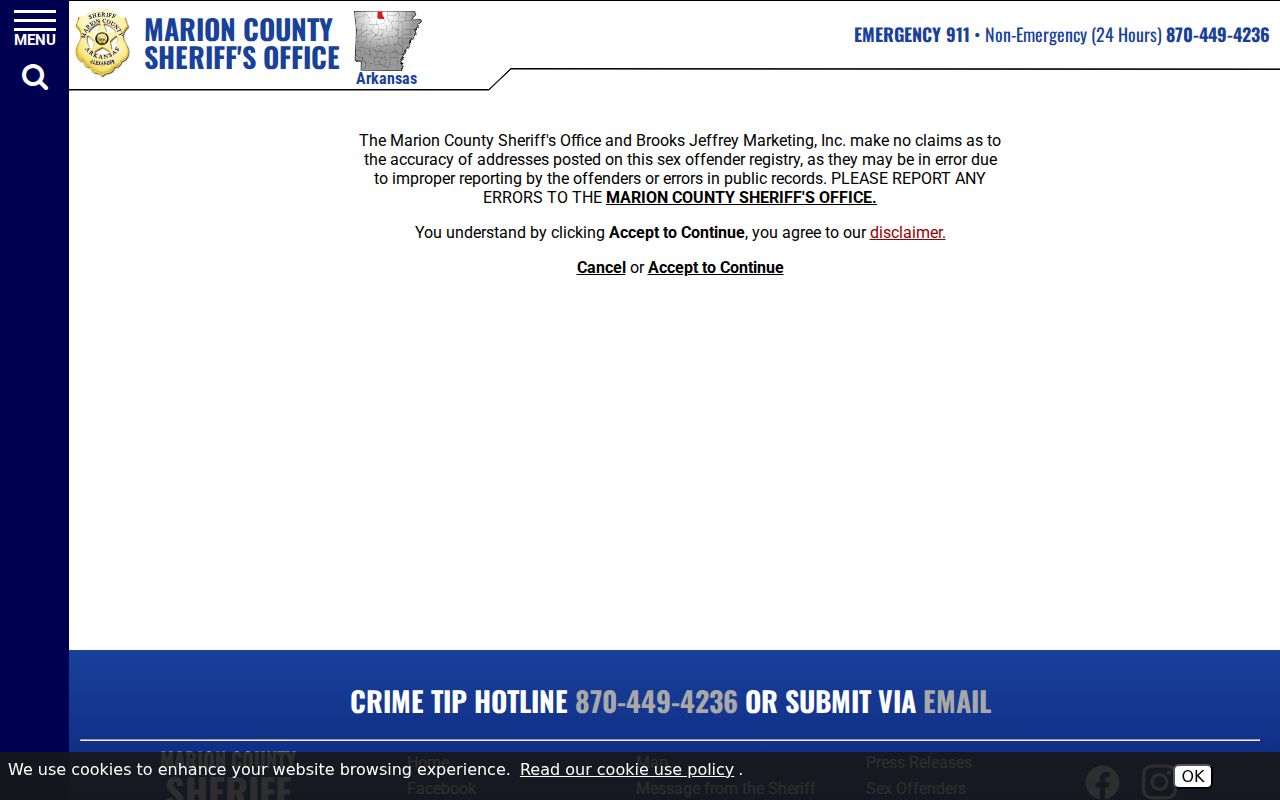
That notice makes the state portal the stronger starting point while preserving the sheriff as the local error-reporting and compliance contact.
Searching the Arkansas Sex Offender Registry
ACIC runs the Arkansas Sex Offender Notification System. Its public interface can narrow the map to Marion County or a smaller place within it. Use only as much personal data as needed, then compare name, image, physical traits, and registration details before deciding that a result matches the person sought.
- Open the Arkansas public registry and review its conditions of use.
- Choose Marion County, a city, ZIP code, address, place, or name filter.
- Review the map or list and distinguish people with similar names.
- Open the profile and read the level, offense, address, and status fields together.
| Search field | Type | Required | Use |
|---|---|---|---|
| Address or place | Text / geocoder | No | Builds a map around a location. |
| City or ZIP | Text / filter | No | Narrows a local place. |
| County | Dropdown | No | Select Marion County. |
| First, middle, last name | Text | No | Searches an identified person. |
| Assessment level | Dropdown | No | Filters public assessment codes. |
| Map or list | Result control | No | Changes the result view. |
The official ACIC search screen is pictured below.
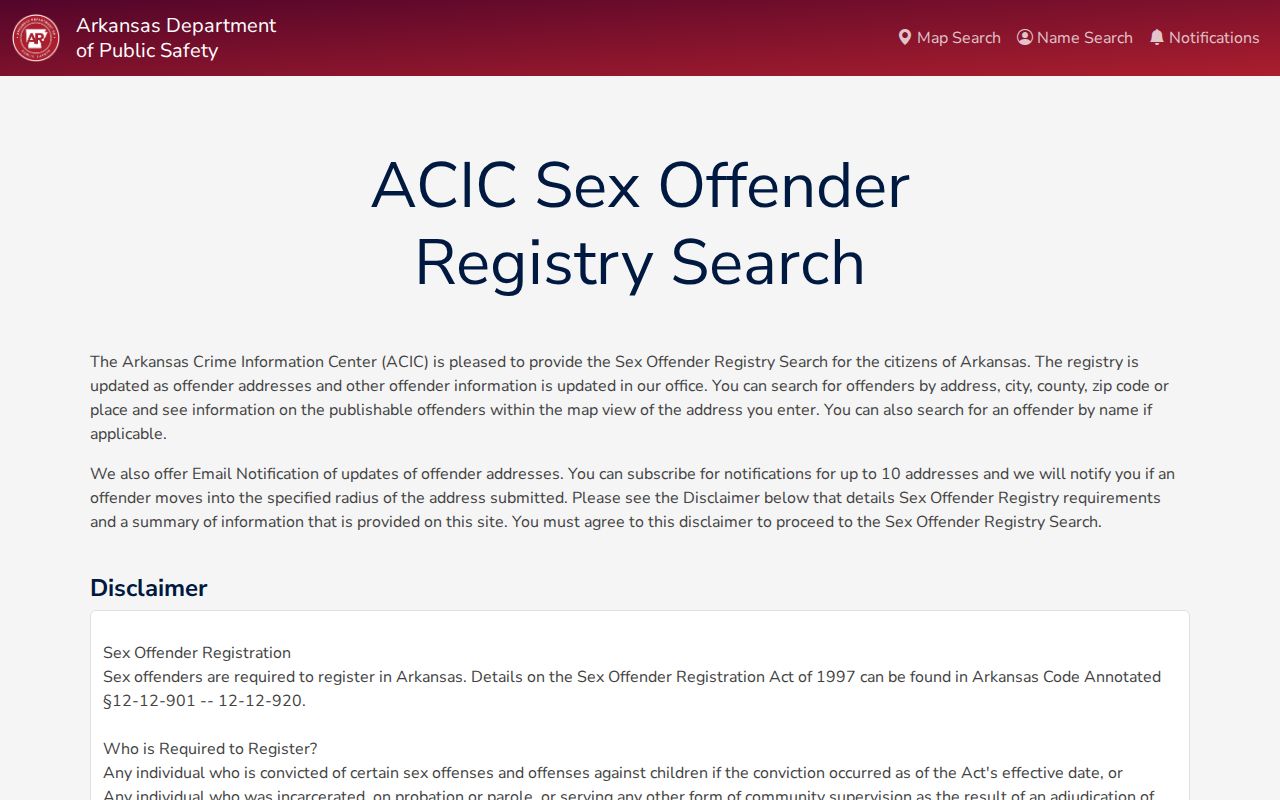
Its county and map tools let a reader focus on Marion County without losing access to the statewide system.
Marion County and National Searches
The ACIC portal is the correct Arkansas layer. The National Sex Offender Public Website adds a cross-state search when the relevant address, travel route, or person may extend beyond Arkansas. NSOPW gathers public registry data from participating jurisdictions. It does not turn Marion County's sheriff list into a national file.
A useful sequence is to search ACIC for Marion County first, note the exact public identifiers, and then repeat the query in NSOPW if another state may matter. Search variations can include a complete name and a location. Compare the returned identifiers rather than assuming that matching names refer to the same person. If the national result points back to Arkansas, return to the ACIC profile for the state's published assessment and registration details.
The official NSOPW source appears below.
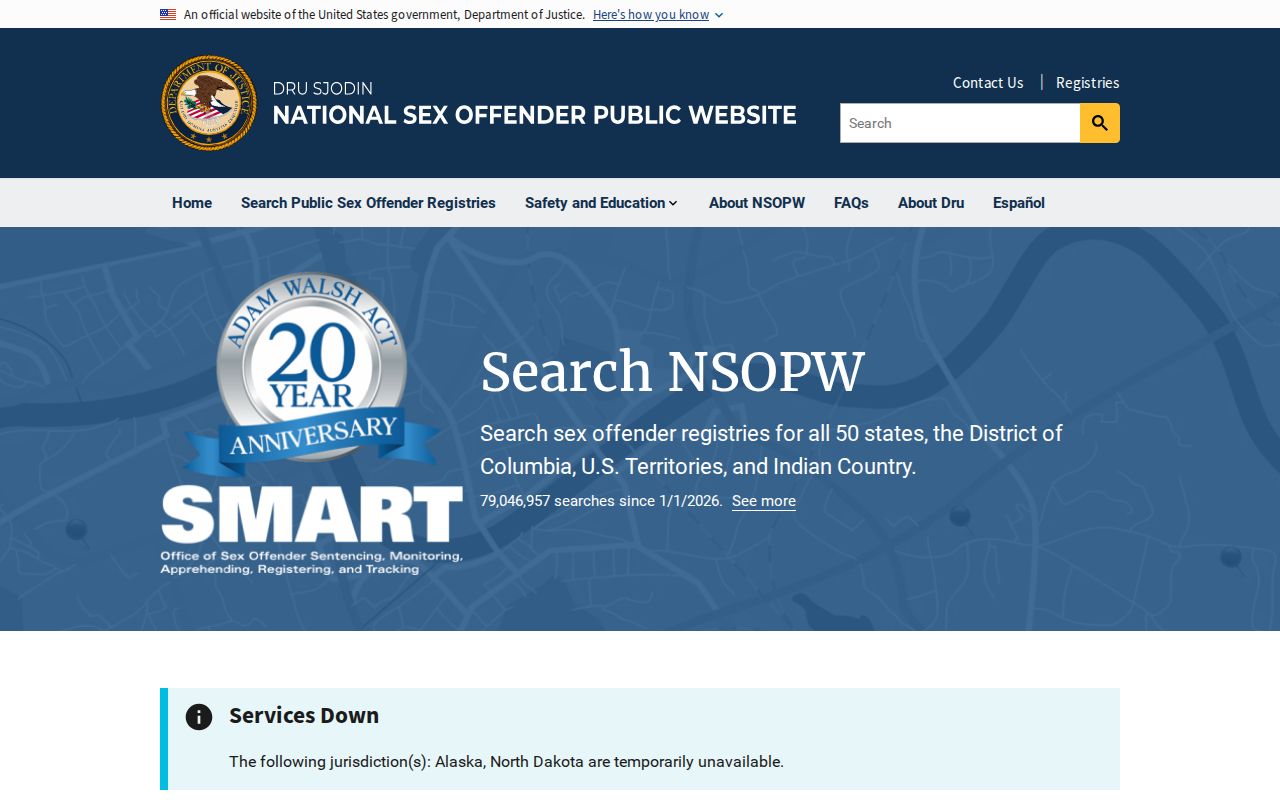
This second layer broadens geographic reach while the Arkansas portal remains authoritative for the state's published records.
What a Marion County Registry Profile Shows
A public profile brings several identifiers together. Read the full set because one common name is not enough to confirm identity. ACIC's code and Arkansas law support display of the fields below when they apply to a publishable registrant.
| Name and aliases | Published identity and known alternate names. |
|---|---|
| Photo and description | Image plus traits such as race, sex, height, weight, hair, and eyes where exposed. |
| Birth information | Date of birth shown under the portal's public rules. |
| Address | Registered location, including block-level fields where the interface exposes them. |
| Offense | Conviction, statute, and date information where shown. |
| Level and status | Assessment level, description, compliance, and registering agency. |
| Other identifiers | Employer, school, vehicle, scars, marks, or tattoos where applicable. |
A profile is a public notification record, not a full criminal case file. Court pleadings, hearing history, and sentencing documents belong to the court channel. The registry focuses on identity, risk assessment, location, qualifying offense data, and registration status.
Employer and school or campus fields can appear when applicable, as can vehicle details and scars, marks, or tattoos. These fields help distinguish identities. They should be read alongside the profile photo, aliases, birth date, and physical description. The registering agency contact is the proper route when two public fields conflict or the status needs clarification.
ARCH Is Not a Marion Registry Search
Arkansas Criminal History, known as ARCH, may state whether the subject of a paid name check is registered or required to register at Levels 1 through 4. That flag answers a narrow criminal-history question. It does not supply the county map, public profile, or local address context available through the sex offender notification portal. ARCH also requires a complete legal first and last name, exact date of birth, and sex, while the registry supports broader place and map filters.
The official ARCH search source shown below illustrates its separate name-check role.
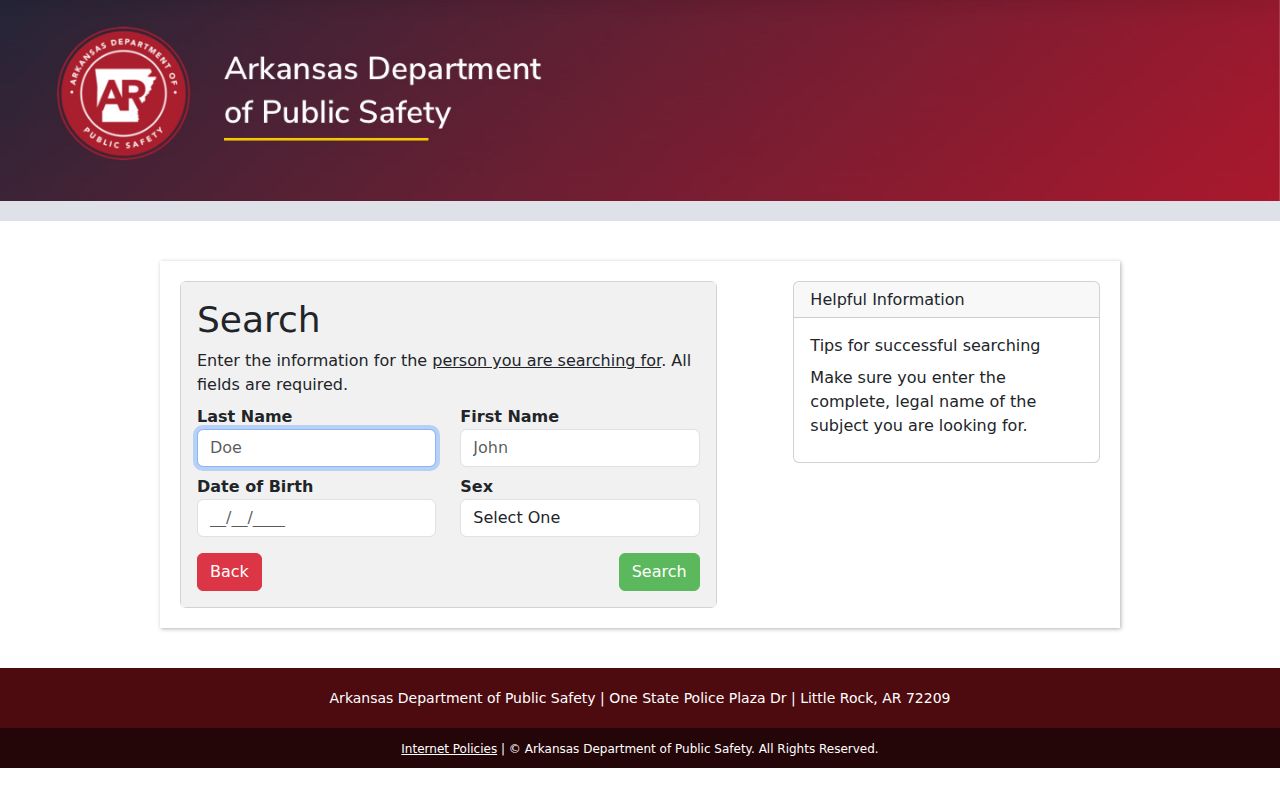
For Marion County community awareness, use ACIC's registry and the sheriff channel. Use ARCH only when its broader Arkansas criminal-history product fits the separate question.
Registration Requirements and Levels in Arkansas
Arkansas public visibility does not treat every assessed registrant alike. ACIC says the public website must provide access to Level 3 and Level 4 offenders, the highest-risk public categories. A recent legal change also brought certain Level 2 offenders into public view when the offender was at least eighteen and the victim was fourteen or younger at the time of the offense. The research does not state a fixed duration or verification schedule for each level, so none should be inferred from the level number.
| Arkansas category | Public display | Research-supported note |
|---|---|---|
| Level 1 | Not generally the main public-web category | ARCH may flag registration status across Levels 1 through 4. |
| Level 2 | Certain offenders are public | Applies to the age and victim-age category described by ACIC. |
| Level 3 | Public website required | One of Arkansas's highest-risk public categories. |
| Level 4 | Public website required | One of Arkansas's highest-risk public categories. |
Assessment level explains public-notification treatment. It should not be used to guess facts missing from a profile. Contact the registering agency when a status or location requires official clarification.
Report Marion County Address Errors
When a listed Marion County address appears wrong, document the profile and the specific problem without approaching the registrant or household. Call the Marion County Sheriff's Office at 870-449-4236. The office is at 221 Randolph, Yellville, Arkansas 72687. The sheriff expressly asks users to report registry errors there.
Suspected non-compliance also belongs with law enforcement. Give the profile name, the address as displayed, and a concise account of what appears inconsistent. The agency can compare the report with registration records. Public users cannot determine compliance merely from an old screenshot or a failed attempt to find someone at an address.
Take care with timing. A move, correction, or agency update may not be reflected on every public screen at the same moment. Record the date and the portal used, but do not publish a claim that a person is out of compliance. That is a law-enforcement finding. When the concern involves the statewide interface rather than the underlying local facts, ACIC is the better contact.
ACIC Manages Marion County Registry Data
The Arkansas Crime Information Center manages the statewide notification system. ACIC can address questions about the portal and the statewide registry layer at 322 South Main Street, Suite 615, Little Rock, Arkansas 72201, or 501-682-2222. Local address and compliance issues should still begin with the Marion County Sheriff's Office.
This split matters. ACIC provides the public platform and Arkansas data framework. Marion County handles the nearby registration and error-reporting role reflected in the sheriff's disclaimer. Searchers get the clearest answer by sending a portal problem to ACIC and a local factual concern to the sheriff.
ACIC also explains which assessment levels qualify for public display under Arkansas law. That role differs from a county deputy's ability to investigate a suspected local reporting problem. A question about why a category is public belongs with the state system. A claim about a Marion County location belongs with the sheriff. Keeping those roles distinct reduces delay and avoids asking an office to alter a record it does not control.
Lawful Use and Marion County Notification
Registry access supports community awareness and personal safety planning. It does not authorize threats, retaliation, harassment, or vigilantism. Arkansas Code § 12-12-913 governs public disclosure of registry information, while the Marion County sheriff warns that anyone who uses the information to commit a criminal act may face prosecution. Site activity may be monitored.
Use registry data lawfully: Misusing Marion County registry information to harass, threaten, retaliate, or commit a crime can lead to criminal prosecution under Arkansas law.
Pause before sharing a profile. Confirm it through the official portal, note when it was viewed, and report suspected errors to the sheriff. These steps protect the public purpose of the notification system and reduce the harm caused by stale or mistaken address information.